


What Your Website Copy Is Saying Without You Realizing It

Your website copy is working harder than you think — just not always in the direction you intend.
The words and phrases you choose tell your reader something beyond their literal meaning. They signal who you're talking to and whether this business is for someone like them. Most of the time that signal is completely unintentional. But unintentional doesn't mean unfelt.
At Eternity, it's something we're committed to: in our own work and in the guidance we give our clients.
What "Accessible Website Copy" Actually Means
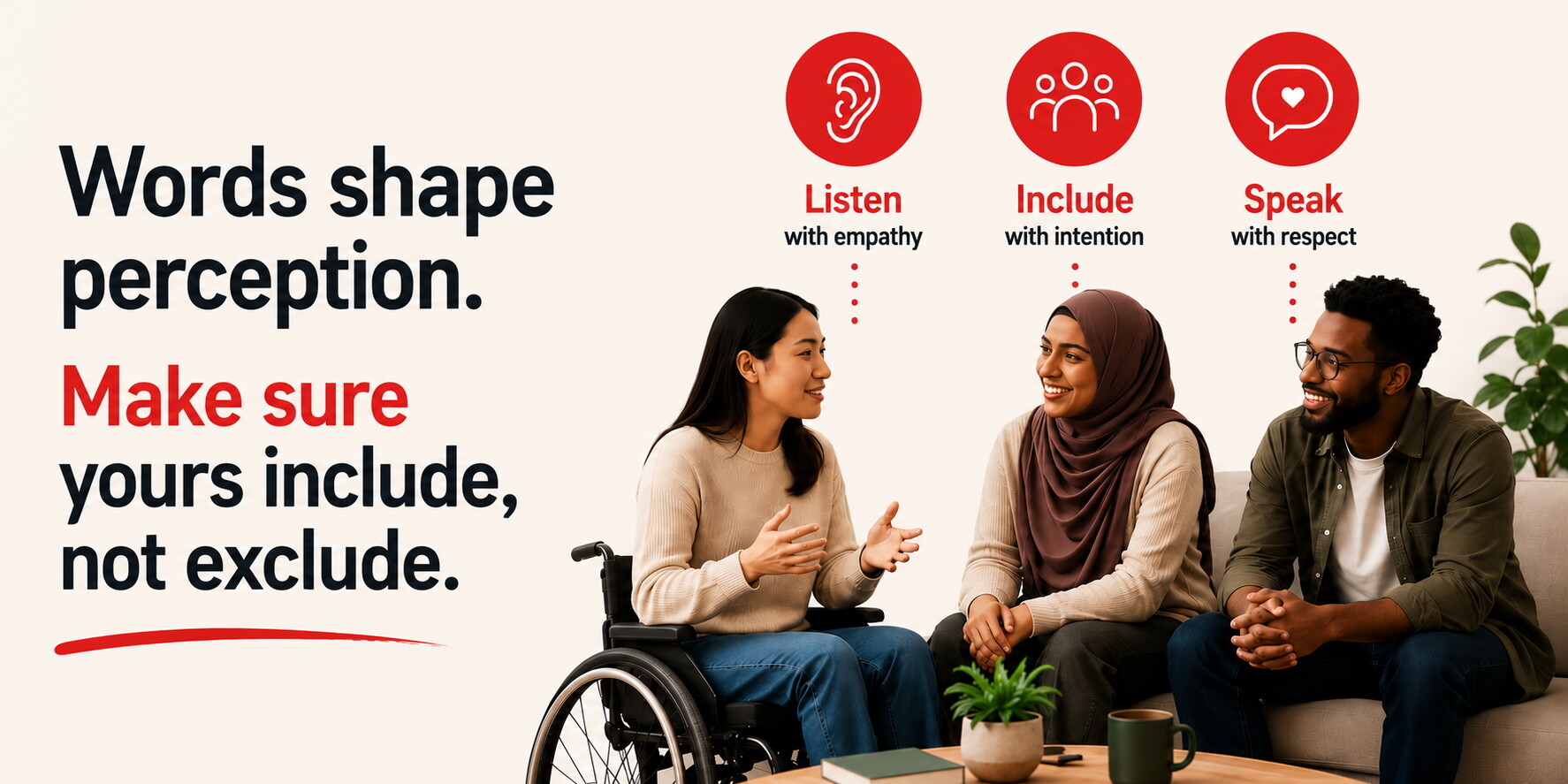
Accessible website copy is content that any reader can understand and engage with, regardless of ability, background, cultural reference point or how their brain processes language.
It’s not a political concept. It’s a communication standard.
When your copy is accessible:
-
It works for the customer who uses a screen reader.
-
It works for the customer who is neurodivergent.
-
It works for the customer who brings a different cultural history to the words you chose.
-
It works for the AI systems now reading and summarizing your site in search results.
All of those readers have one thing in common: they need your words to mean what you intend them to mean, without requiring context you haven't provided.
Accessible copy is also, practically speaking, better copy. It tends to be more specific and clearer to follow.
Why This Is Harder Than It Sounds
The phrases most likely to land badly are the ones that feel the most harmless. That's what makes them easy to miss.
Nobody needs a checklist to flag an obvious slur. What slips through are the expressions so embedded in everyday language that questioning them takes a deliberate pause.
Here are the four patterns worth knowing:
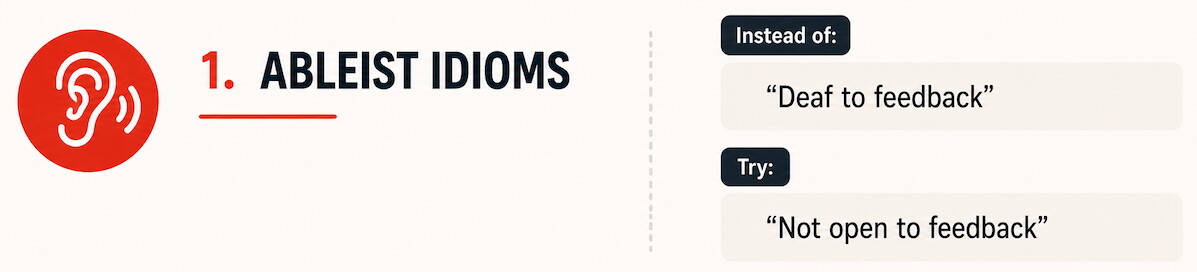
Ableist idioms show up constantly in marketing copy. "Turn a blind eye." "Fall on deaf ears." "That's crazy good." "Lame excuse."
On a website, it shows up as "We won't turn a blind eye to your results" or "Our process is crazy effective." Neither phrase is meant to harm anyone. That's exactly what makes it easy to leave in.
These phrases use disability as a negative shorthand. They feel like neutral expressions because they've been used so frequently their origins have become invisible.
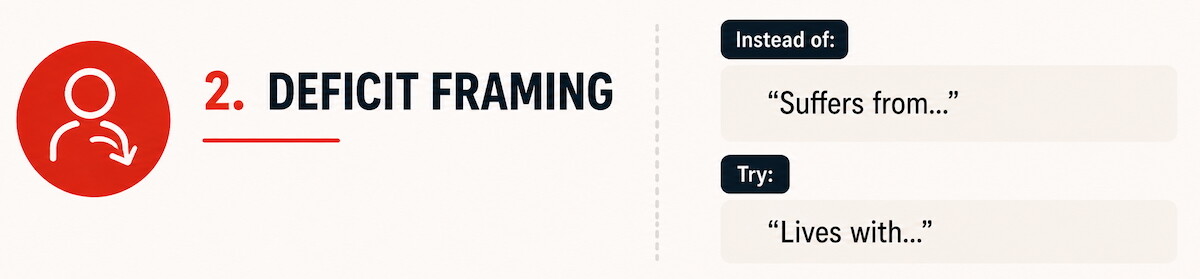
Deficit framing describes a reader's situation using language that positions them as broken before being offered anything useful.
Words like "struggling," "suffering," "failing to," and "can't figure out" are common in marketing copy because they're meant to create urgency. For many readers, they create distance instead.
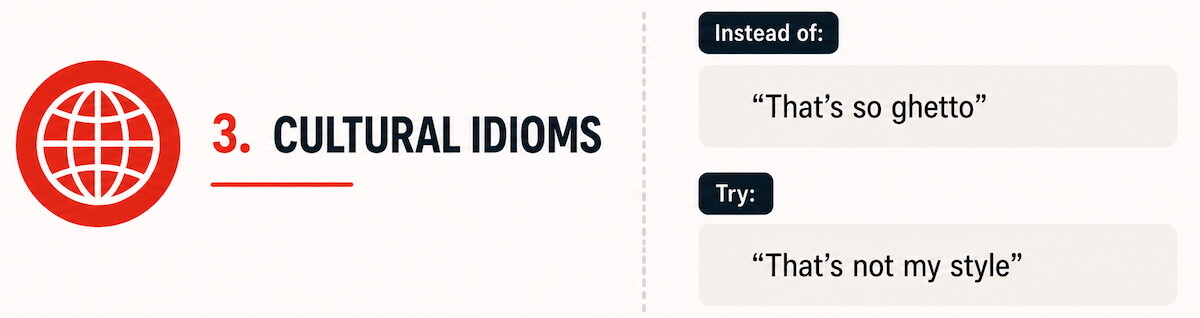
Culturally specific idioms assume a shared reference point that not every reader has.
A phrase can feel completely neutral to the person writing it while carrying a specific and painful history for someone reading it. When you're unsure of an expression's origins, plain language is always the safer choice.
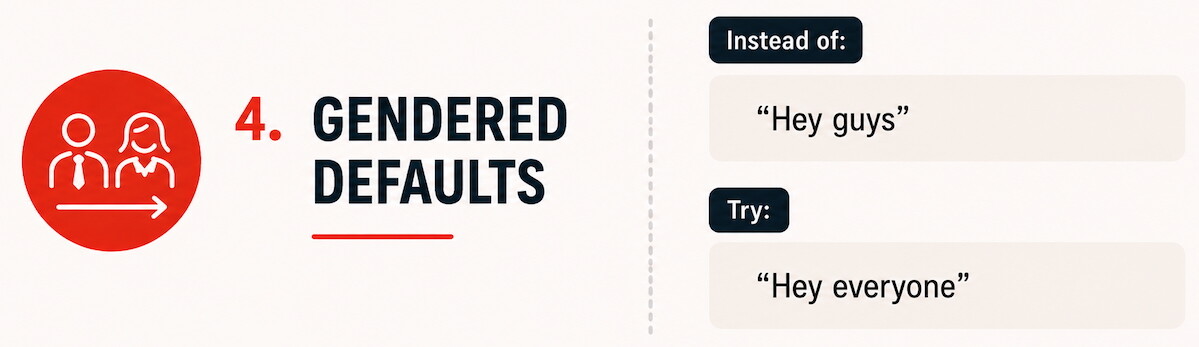
Gendered defaults still appear regularly in business copy. "Hey guys" as a universal greeting. "Man hours." Defaulting to "he" for a professional or authority figure without thinking about it.
On a website it looks like "Whether you're a businessman or entrepreneur" or a service page that defaults to "he" when describing a client or professional.
These feel like small choices. For readers who aren't included in the default, they accumulate.
Where AI Fits Into This
Before AI generates a single word, what you put in matters just as much as what you do with what comes out. AI works best when it starts from your expertise — your brand voice and how you talk to your audience. Without that context, it defaults to generic. With it, the output starts from a much more informed place and requires less correction on the back end.
A branding document is one of the most practical ways to build that foundation. It captures your voice, tone, positioning, and audience in one place — and becomes the context you hand to AI before the conversation starts.
Eternity's free Branding Copy Doc Builder creates one based on your website and your own input. Think of it as doing the thinking before the typing — so when AI enters the process, it's working from something real.
If you're using AI tools to generate website copy, this conversation is directly relevant to you.
AI writes the way the internet writes. It has been trained on enormous quantities of text, which means it has absorbed the full range of how people communicate online — including every idiom, gendered default and culturally loaded phrase that appears frequently enough to feel normal. It reproduces all of it fluently, because fluency is what it was built for.
This isn’t a reason to avoid using AI for your copy. It’s a reason to read AI-generated output with the same care you'd bring to anything you're about to publish under your business's name.
A useful frame: if you wouldn't publish a first draft from a human writer without reviewing it, don't publish a first draft from an AI without reviewing it. The standard doesn't change because the source does.
There is one specific thing worth doing when you review AI-generated copy: run a second pass focused only on idioms and figures of speech. A general read will catch obvious issues. Ableist idioms and culturally loaded phrases are easy to miss on a general read because they feel normal. A targeted pass catches them.
A Practical Guide for Reviewing Your Website Copy
Use this list before publishing any website copy, whether you wrote it yourself or generated it with AI. The Web Content Accessibility Guidelines from the W3C are the recognized standard for digital accessibility — the guidance below is grounded in the same principles.
Language and phrasing
-
Read the copy aloud. Hearing words creates a different kind of attention than scanning them. If a phrase makes you pause, even briefly, pay attention to that pause.
-
Flag every idiom and figure of speech. If you're not certain of its origins, look it up. If it has a cultural or historical context you weren't aware of, replace it with plain language.
-
Scan for deficit framing. Search for words like "struggling," "suffering," "failing," and "can't." Ask whether each one is accurate, necessary and respectful of the reader.
Representation and defaults
-
Check your gendered language. Replace catch-all uses of "guys" with "everyone" or "your team." Use they/them when referring to a hypothetical person. Check that authority figures and professionals aren't defaulted to one gender.
-
Look for urgency and shame. Copy like "Don't make this mistake" or "You're already behind" uses discomfort as a motivator. Ask whether that framing reflects how you want your business to treat people.
If AI-generated
-
Run a second pass focused specifically on idioms. AI output reads naturally on a first pass. A second read with idioms as your only focus will catch things a general review misses.
-
Ask this question once before you publish: Is there anyone this copy might exclude, dismiss or send the wrong signal to — even without intending to?
You won't catch everything every time. That's not the goal. The goal is to build the habit of looking. I'm still building it too.
Why This Makes Business Sense Too
Accessible copy reaches more people, and plain language performs better in both traditional search results and AI-generated answers. Inclusive framing signals to readers that your business is one they can trust.
And beyond the metrics: your website is often the first thing a potential customer sees. The words on it are telling people whether they belong in your world or not. Most of the time, that signal is completely unintentional.
The good news is that fixing it doesn't require starting over. It requires a second look — with a slightly broader set of readers in mind than the one you were picturing when you wrote it.
If Your Website Is Overdue for a Refresh
Website copy written with this level of care doesn't happen by accident.
When Eternity writes your website copy, AI is part of our process too. We use it as a thinking partner — to shape ideas, pressure-test language and draft alongside human judgment, not instead of it. And everything it touches gets the same level of scrutiny this article is asking you to apply. That's not an extra step. It's just how we work.
Frequently Asked Questions
